Introduction
The shift towards digital signaling systems is reshaping railway operations across Europe and beyond. At the forefront of this transformation is the European Train Control System (ETCS)—a core component of the European Rail Traffic Management System (ERTMS). As legacy signaling solutions age and interoperability becomes more critical, ETCS offers a unified, safe, and scalable alternative.
In this article, we explore how transitioning to ETCS impacts railway safety, operations, and RAMS compliance—and what railways should expect in the journey toward full digitalization.
What is ETCS Signaling System?
The European Train Control System (ETCS) is a standardized automatic train protection (ATP) system designed to:
- Replace incompatible national signaling systems,
- Improve cross-border train interoperability,
- Enhance safety through continuous train supervision.
ETCS is part of the broader ERTMS program and is designed for scalability and backward compatibility.
ETCS Levels: A Progressive Roadmap
Understanding ETCS requires familiarity with its three implementation levels, each providing incremental digitalization:
🔹 ETCS Level 1
- Overlay system on existing national signaling (fixed blocks).
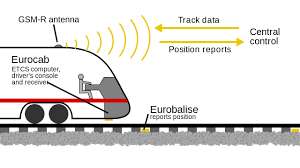
- Uses Eurobalises and Lineside Electronic Units (LEUs).
- Train receives movement authority via balises.
🔹 ETCS Level 2
- No lineside signals required.
- Continuous GSM-R communication with Radio Block Center (RBC).
- Supports higher speeds, improved headways, and better safety diagnostics.
🔹 ETCS Level 3 (Future)
- Moving block system, no trackside detection equipment.
- Relies on train integrity reports and constant position updates.
- Enables dynamic headways and highest capacity efficiency.
Benefits of Transitioning to ETCS Signaling System
✅ Safety Improvements
- Real-time speed supervision, braking curve enforcement, and automatic intervention.
- Removes human error from signal interpretation.
✅ Interoperability
- Enables seamless cross-border traffic across European networks without system changes onboard.
✅ Operational Efficiency
- Reduces reliance on lineside infrastructure, decreasing maintenance needs.
- Optimizes headways, increasing line capacity.
✅ RAMS Optimization
| RAMS Element | ETCS Contribution |
|---|---|
| Reliability | Fewer hardware interfaces, digital architecture. |
| Availability | Continuous data transmission minimizes disruptions. |
| Maintainability | Modular, software-based upgrades streamline upkeep. |
| Safety | Continuous supervision eliminates signal passed at danger (SPAD) risks. |
Key Challenges in the Transition
Despite its advantages, migrating to ETCS brings technical and operational challenges:
⚠️ Legacy System Compatibility
Integrating ETCS into existing infrastructure often requires hybrid operation with national systems during the transition phase.
⚠️ Training and Human Factors
Drivers, dispatchers, and maintenance staff need new competencies—especially in interpreting DMI (Driver Machine Interface) signals and managing degraded modes.
⚠️ Investment and Migration Costs
High upfront costs in infrastructure adaptation, especially for Level 2 and beyond, must be justified by long-term savings.
Real-World Example: ETCS Level 2 on Swiss Mainlines
Switzerland has implemented ETCS Level 2 extensively. Results include:
- Reduction in SPAD incidents by over 50%.
- Increased punctuality on dense routes like Zürich–Bern.
- Gradual decommissioning of legacy signals, reducing maintenance costs.
Looking Ahead: The Role of ETCS in the Digital Railway
The transition to ETCS is not merely a tech upgrade—it’s a strategic pillar for achieving full digital railway ecosystems. Coupled with Traffic Management Systems (TMS) and Digital Automatic Couplers (DAC), ETCS lays the groundwork for:
- Autonomous train operations,
- Integrated RAMS dashboards,
- Real-time traffic optimization.
Conclusion
ETCS represents a paradigm shift in how railways manage safety, capacity, and interoperability. Transitioning requires thoughtful planning, but the rewards in RAMS performance, operational resilience, and network harmonization are substantial. As Europe marches toward full ERTMS integration, now is the time for infrastructure managers and operators to align on strategy and execution.gement will further amplify its impact on RAMS compliance.
Further details of the ETCS system can be foud HERE.
To learn more about railway safety and engineering, explore our RAMS training courses at https://ramsrail.com/rams-courses/.